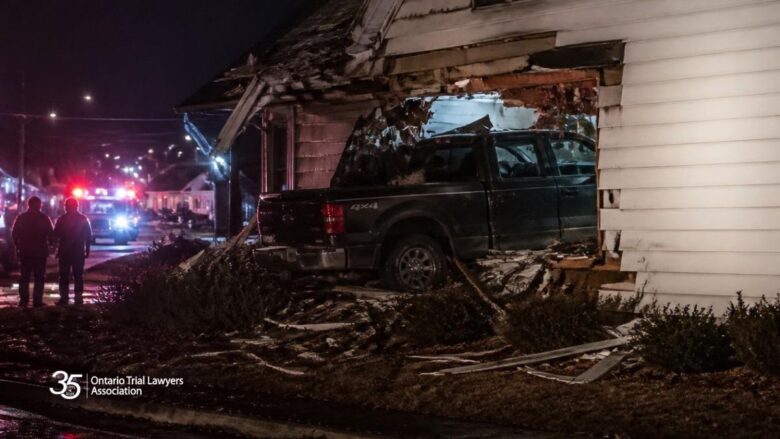
At approximately 4:30 am on June 29, 2023, Wilfred Poisson and his partner were asleep in their home when a pick-up truck crashed into the first floor of their home. The impact triggered the smoke detectors, which activated flashing strobe lights and a voice alarm repeatedly calling out “Fire, Fire, Fire.” Mr. Poisson was jolted awake in a state of panic, got dressed and went downstairs to investigate. He found the truck embedded in the wall of his house with its headlights beaming through the structure, and when he looked outside, he saw a person lying motionless on the driveway whom he believed to be dead. He called 911 to report the incident.
Mr. Poisson subsequently applied for accident benefits under his personal motor vehicle policy, seeking funding for psychological treatment arising from the incident. Intact Insurance Company (Intact) denied coverage, taking the position that Mr. Poisson was neither an “insured person” nor involved in an “accident” as those terms are defined under the Statutory Accident Benefits Schedule (SABS).
The Licence Appeal Tribunal (LAT) was asked to decide:
1) Whether Mr. Poisson was involved in an “accident” as defined in s.3(1) of the SABS
2) Whether he met the definition of an “insured person” under that same provision
On the question of whether an “accident” had occurred, Intact argued that the pick-up truck had ceased operation by the time Mr. Poisson’s psychological impairments arose and that his injuries were therefore not directly caused by the use or operation of an automobile. Intact characterised his psychological harm as stemming from witnessing the aftermath of the collision — the property damage, the unconscious driver on the driveway, the near-miss of a gas line and the ongoing disruption caused by home repairs — rather than from the collision itself. Intact further argued that the smoke detectors, strobe lights and displacement from the home were independent sources of distress that constituted intervening events breaking the chain of causation. In support of its position, Intact relied on the Divisional Court decisions in Francia v. Economical and Travis v. Aviva Insurance Company as well as the LAT decisions in Howes v. CAA Insurance Company, 023 CanLII 42592 (ON LAT) and Gray v. Intact Insurance, 2023 CanLII 133 (ON LAT) all of which involved applicants who suffered psychological harm after coming upon or witnessing the aftermath of an accident.
Mr. Poisson’s position was fundamentally different. He argued that his psychological impairments arose from the impact of the truck hitting his house while he was inside it. He submitted that the moment the truck struck the home, he was jolted awake by the crash, heard the alarms, saw the strobe lights and immediately experienced terrifying fear and panic — a continuous and uninterrupted chain of events flowing directly from the use and operation of the vehicle. He argued that the cases relied upon by Intact were distinguishable because those involved individuals who came upon an accident scene after the fact, whereas he was present at the very moment of impact.
Adjudicator Malach applied the two-part test established by the Ontario Court of Appeal in Economical Mutual Insurance Company v. Caughy, 2016 ONCA 226, which requires satisfaction of both a purpose test and a causation test.
On the purpose test, the adjudicator found that the incident arose out of the use or operation of an automobile, as driving a vehicle is an ordinary and well-known activity to which automobiles are put. She accepted Mr. Poisson’s characterisation of events and rejected Intact’s framing, finding that his psychological impairments resulted from the impact of the truck hitting his house — not from witnessing the aftermath — and that the cases relied upon by Intact were distinguishable on that basis.
On the causation test, the adjudicator found that Mr. Poisson’s injuries would not have occurred but for the pick-up truck driving into his house. She then considered whether any intervening act had severed the chain of causation and concluded that none had. The sequence of events — the crash, the alarms, the strobe lights, the panic — was a series of uninterrupted occurrences flowing directly from the use and operation of the vehicle. She further found that the dominant feature of the incident was the truck crashing into the home, which startled Mr. Poisson awake and caused his psychological impairment, and that it was reasonable to expect that an ordinary person would suffer such an impairment from enduring that traumatic experience.
The adjudicator also found that because his injuries arose directly from the accident itself — and not from its aftermath — Mr. Poisson was “involved” in the accident within the meaning of s.3(1)(a)(i) of the SABS.
Congratulations to OTLA member Jeffery Crannie, counsel for the plaintiffs, on the win!