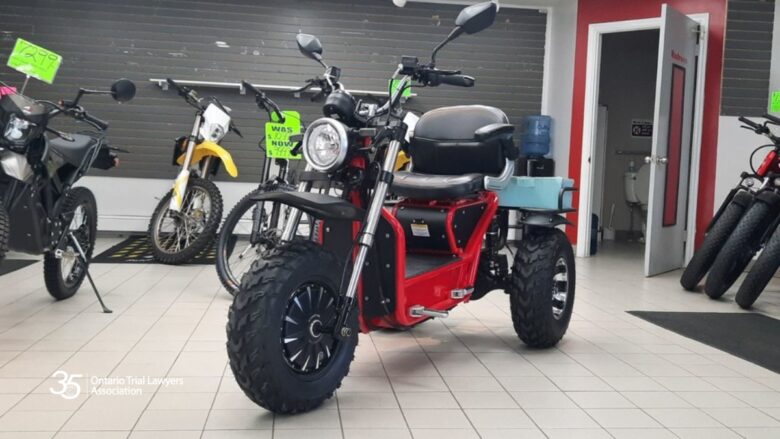
The Licence Appeal Tribunal (LAT) determined that a Boomer Beast 2 D Deluxe is an “automobile” in ordinary parlance rendering the incident an “accident” under s.3(1) of the Statutory Accident Benefits Schedule (SABS).
In this case, the applicant was involved in an accident in August of 2023, while operating a Boomer Beast 2 D Deluxe (the “Boomer Beast”) electric three-wheel vehicle. The vehicle “spontaneously broke” causing the applicant to fall onto the road and sustain injuries. The applicant subsequently applied for benefits and was denied by the respondent and applied to the LAT for resolution of the dispute.
Procedural Issue
The LAT first dealt with a procedural issue. The applicant included new evidence, a Daymak Inc. catalogue, in his reply submissions. The respondent, instead of requesting that the catalogue be excluded, sent an email to the LAT indicating what had happened and included two paragraphs of additional submissions to address the catalogue. The applicant attempted to argue that the respondent made submissions out of turn, that the catalogue was publicly available and its inclusion was in direct response to an issue raised by the respondent. However, Adjudicator Levitsky permitted the additional submissions as they adequately mitigated any prejudice arising from the late introduction of the evidence.
Accident?
The LAT then went on to address whether the applicant was involved in an “accident” as defined in s.3(1) of the SABS. In her analysis, Adjudicator Levitsky relied on the three-part test to determine if a vehicle is considered an “automobile” from Adams v. Pineland Amusement Ltd. et al., 2007 ONSC 844:
- Is the vehicle an “automobile” in ordinary parlance?
- If not, then is the vehicle defined as an “automobile” in the wording of the insurance policy?
- If not, then does the vehicle fall within any enlarged definition of “automobile” in any relevant statute?
Relying on Grummett v. Federation Insurance Co. of Canada, 1999 CanLII 15103 to determine whether the vehicle was an “automobile” in ordinary parlance,Adjudicator Levitsky ultimately determined that the Boomer Beast met the first step of the Adams test. Under Grummett, when determining whether a vehicle is an “automobile” in ordinary parlance, it is appropriate to consider the purpose and function of the vehicle. The Boomer Beast is a road legal electric three-wheeled vehicle measuring 72 inches by 39 inches by 58 inches with a maximum speed of approximately 40km/h, equipped with headlights, brake lights, handlebars, a seat with a back and tires measuring 16 and 21 inches. Its catalogue described it as a mobility scooter capable of on and off-road use, “road legal” and operable without a licence or insurance.
Given the above factors, Adjudicator Levitsky was able to distinguish the Boomer Beast from the race car in Grummett, which was designed for competitive racing, didn’t have head lights, brake lights or doors, and the accident did not occur on a public road. On the other hand, the purpose and the function of the Boomer Beast was for it to be used on and off road. Further, the Boomer Beast was being operated on a public road when the accident occurred, something it was designed to do and it was equipped with a brake light, handlebars, three wheels and a seat, it is propelled by a mechanism other than muscular power, and has the function of transporting a person. Adjudicator Levitsky, additionally acknowledged that despite the list in Grummet, there is an absence of caselaw with a binding list of factors which are mandatory for a vehicle to be considered an automobile.
The respondent submitted that under the Government of Ontario webpage entitled “Pedestrian Safety,” scooters are for people with limited mobility and are considered pedestrians under the Highway Traffic Act, R.S.O. 1990, c. H.8. However, given the features noted above, Adjudicator Levitsky did not agree. While she agreed that mobility scooters are designed to assist individuals with mobility issues, she was not convinced that this precluded it from being an automobile as well, as no where in the catalogue or webpages does it indicate that the Boomer Beast is designed or permitted to be used on sidewalks, indoors or other areas frequently used by pedestrians. “In fact, the size and speed of the Boomer Beast signals to me that, unlike a typical mobility scooter, its purpose and function was not for it to be driven in pedestrian areas.”
Adjudicator Levitsky acknowledged that this ruling may have consequences for insurers where individuals with insurance for a specific vehicle operates a mobility device, sustains an injury and then claims and receives benefits, however she was bound by the analysis set out in Grummett. Further, she noted that the ordinary parlance test focuses on purpose and function, not insurer consequences. Ultimately the SABS is a consumer protection legislation that must be interpreted accordingly and clear legislative or judicial direction would be required before the LAT could depart from that analysis.
Adjudicator Levitsky was not satisfied with the respondent’s submission that vehicles that travel on public roads and highways can generally travel over 100km/h, but the Boomer Beast cannot travel over 40km/h. It is just one element that is to be considered and does not supplant the other elements that indicate that it is an automobile in ordinary parlance. Ultimately, it was found that the Boomer Beast is designed for and capable of transportation of passengers on streets and highways and therefore is an “automobile” in ordinary parlance per Grummett, and the applicant was accordingly involved in an “accident” pursuant to s. 3(1) of the SABS.
Attendant Care
Finally, Adjudicator Levitsky determined that the applicant is not entitled to the treatment plan for the attendant care assessment in dispute. She was not satisfied by the applicant’s argument that an insured person is automatically entitled to attendant care assessments so long as they have sustained an injury that is not minor. The applicant had the onus of proving on a balance of probabilities that the fees charged were reasonable and the assessment necessary for the preparation of an attendant care needs form and this was not done. The applicant had made no submissions as to whether the fees were reasonable or why the assessment was necessary. The only medical evidence relied upon was an x-ray indicating that he had a fractured clavicle. It was submitted that the cost of the assessment was incurred but there was no resulting report or assessment of attendant care needs form provided to the LAT. Evidence of a fractured clavicle alone was not sufficient to prove that an assessment form was necessary for the preparation of an attendant care needs form.