Background
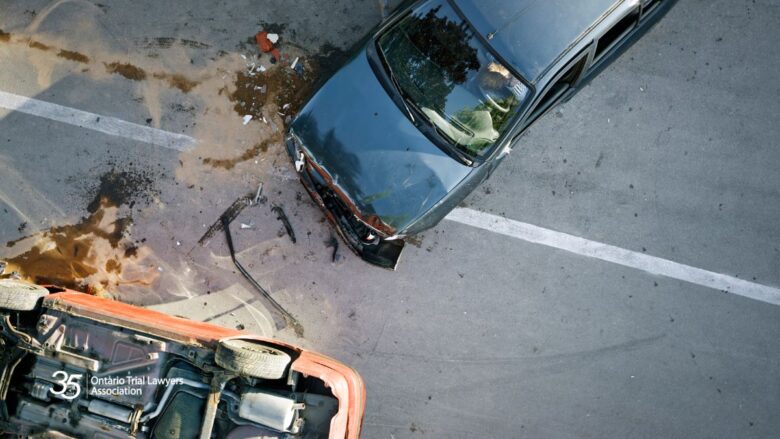
This action arose from a 2015 motor vehicle collision that occurred on a narrow, unpaved rural road in Renfrew County in which the plaintiff, Emmett Recoskie, sustained severe injuries. The two vehicles involved were one driven by Jackson Vandenheuvel (carrying Recoskie as a passenger) and a vehicle driven by John Prince. Prince had been travelling east at the same time the Vandeheuvel vehicle was travelling west. As the Vandenheuvel vehicle descended over the blind crest of a hill on that roadway, it crossed over the centre line, striking the Prince vehicle head-on.
Vandenheuvel was uninsured. Thus, the plaintiffs sued their own insurer, Co-operators General Insurance Company (Co-operators), under their OPCF 44R endorsement. Under Ontario’s joint and several liability framework, if Prince was found even 1% liable, his insurer would be required to pay the full judgment. If there was any other motor vehicle coverage available, Recoskie’s coverage under the OPCF-44 endorsement would not apply. Co-operators was stepping into the shoes of Vandenheuvel.
The parties conceded that Vandenheuvel was at least partially at fault for crossing the centre line.
Issues
The sole issue at trial was whether Prince was at least 1% liable for the collision.
Evidence and Findings of Fact
Justice Hooper considered the evidence from the parties, as well as the responding OPP officer and the forensic engineering expert called by Prince.
The court ultimately relied on the OPP officer’s measurements setting the road width at 23.5 to 24.5 feet, as Co-operators offered no competing evidence. Simulations by Prince’s forensic engineer placed Prince in his proper eastbound lane and showed him both braking and reducing his speed before impact. Co-operators did not call any expert witness to rebut this. Prince testified that he was driving in his own lane, hugging the far-right foliage to avoid oncoming traffic. Vandenheuvel admitted to crossing the centre line.
While there were some inaccuracies with Prince’s evidence, particularly with respect to his perception of the width of the roadway and the scene’s proximity to a neighbouring property, the court found Prince to be overall a credible witness.
Additionally, the court noted that Co-operators’ subsequent surveillance of Prince’s driving, obtained years after the collision, as well as their line of questioning on his driving habits, was irrelevant to the issues at trial.
Analysis
- Prince’s actions would not have caused the collision absent the negligence of Vandenheuvel
Co-operators, standing in the shoes of Vandenheuvel, had the burden of rebutting the presumption that he was entirely at-fault for this collision. They could attribute some of the liability to Prince if they could prove that with exercise of reasonable care, he had sufficient opportunity to avoid the collision but failed to do so.
Based on the forensic engineering evidence submitted by Prince and Vandenheuvel’s own admission that he was driving over the centre line, the court found it was more than probable that Prince was driving in his eastbound lane as he ascended the hill prior to the collision. Driving “close” to the centre line, but not over it, would not have caused this collision absent Vandenheuvel’s own negligence in crossing the centre line.
A driver has the right to operate their vehicle on their side of the roadway and assume that other drivers will do the same. Driving in one’s own lane, close to, but not over the centre line, will not create liability absent something more (Recoskie v. Vandenheuvel et al., 2025 ONSC 5856 at para 43).
- No evidence that Prince taking different actions would have resulted in a different outcome
A central argument of Co-operators’ case against Prince was that Prince was travelling too fast given he could not see over the crest of the hill, leaving him with insufficient time to react to the emergent situation Vandenheuvel created by crossing into his lane.
The court noted that while a driver traveling into a blind spot should reduce his or her speed to be able to react to a sudden emergency, there must be some evidence as to what would have made a difference. Sometimes collisions cannot be avoided, even by a driver with sufficient time to react (Ibid at para 51).
Until Vandenheuvel crested the hill, Prince had been unaware there was an oncoming vehicle that had crossed the centre line and was barreling towards him. It is only at the point that the emergent situation arises when the actions of the reacting driver should be considered. Here, there was a complete absence of evidence of what could or should have happened next, including:
- How far up the hill Prince’s eastbound vehicle would have been when Prince would have first become aware of an oncoming vehicle;
- The distance between the vehicles at that point
- How a difference in speed of the Prince vehicle would have changed Prince’s reaction time
- Available evasive measures to Prince on this narrow roadway
- How such evasive measures would have reduced the severity of the injuries to Emmett Recoskie
Conclusion
The court dismissed the action against Prince, finding there was not enough evidence to find that Prince caused the collision, even at 1% liability.
What we can take away from the Recoskie decision is the importance in calling expert evidence on liability issues. In failing to call their own expert to speak to liability, Co-operators left the court with little choice but to rely on the expert evidence called by Prince. It is likely that an opposing expert would have been able to speak to the question of: “what could have or should have happened next.”
Additionally, the decision provides a helpful review of the settled law with respect to partial responsibility of a driver with the right of way (including excessive speed and a failure to avoid a collision), particularly helpful to new practitioners (and those of us who may benefit from a refresher!) (Ibid at para 47;Walker v. Brownlee and Harmon, 1952 CanLII 328 (SCC), [1952] CarswellOnt 395 (SCC) and Sant v. Sekhon, 2013 ONSC 2982).